
|


• Washington Post SCOOP ALERT: It now appears Special Counsel Robert S. Mueller is investigating the finances and business dealings of Jared Kushner, President Trump’s son-in-law and adviser, as part of the probe into Russia’s interference in the 2016 presidential election. This follows yesterday’s revelation that the special counsel was interviewing officials regarding the possibility of Trump himself having obstructed justice. Trump, for his part, took to Twitter to angrily denounce the investigation and once more rage about the supposed perfidy of Hillary Clinton, whom he defeated in the election last November. Separately, a report in the Guardian detailed how Attorney General Jeff Sessions attended at least two dinners with a known American lobbyist for Russia, contradicting his sworn testimony this week before a Senate hearing. • Two jokes made by foreign leaders about Trump seem to encapsulate the American president’s predicament. At a phone-in session with the Russian public, President Vladimir Putin made a sarcastic offer of asylum to ousted FBI director James B. Comey. He first joked that Comey’s leak of a memo discussing Trump’s overture to him was not unlike the efforts of NSA whistleblower, Edward Snowden, who claimed asylum in Russia. “That means [Comey] is not the leader of the security services, but a human rights defender. And if he faces pressure, then we are happy to offer him political asylum, too,” said Putin. Trump has complained about how the pressures of the Russia investigation have hampered his efforts to reset relations with Moscow. On the same day, footage emerged of Australian Prime Minister Malcolm Turnbull mocking Trump at a press ball. “Donald and I, we are winning and winning in the polls,” said Turnbull. “We are winning so much. We are winning like we have never won before.” To raucous laughter, he continued: “We are winning in the polls. We are, we are — not the fake polls, not the fake polls — they’re the one we’re not winning in. We’re winning in the real polls, you know, the online polls. They are so easy to win.” It’s a light-hearted gag, but may not go over so well for the notoriously thin-skinned Trump. • Otto Warmbier, the American college student evacuated from North Korea this week, is said to have suffered extensive loss of brain tissue and is in a state of “unresponsive wakefulness.” More from my colleagues: “Doctors said they don’t know what caused the brain damage. When asked whether it could be the result of beating or other violence while in prison, they said that Warmbier did not show any obvious indications of trauma, nor evidence of either acute or healing fractures… It has been almost a year and a half since Warmbier was detained in North Korea, which he had visited on a five-day tourist trip on his way to a study-abroad trip to Hong Kong with the University of Virginia. On his last night there, he apparently tried to remove a large propaganda sign. He was charged with ‘hostile acts against the state’ and, after a sham trial, sentenced to 15 years of hard labor.” Meanwhile, another American — former basketball star and television jester Dennis Rodman — is still in North Korea. He was captured by cameras gifting a copy of Trump’s “The Art of the Deal” to the North Korean sports minister. There’s a chance Rodman will meet with Kim Jong Un this weekend. |

 |
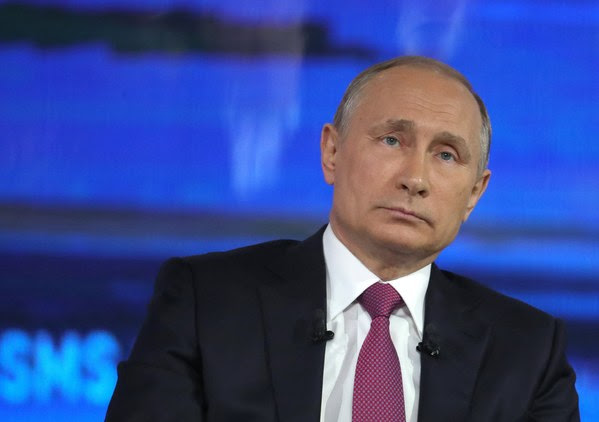
Russian President Vladimir Putin during his annual ‘Direct Line with Vladimir Putin’ TV and radio call-in broadcast in Moscow on June 15. (Pool photo by Michael Klimentyev/European Pressphoto Agency via Sputnik) Nothing to see here, folks Facing a wave of popular unrest not seen in years, Russian President Vladimir Putin took to the nation’s airwaves Thursday to assure citizens their lives will be getting better. But judging from the questions Putin fielded over four long hours, Russians aren’t feeling it. Just three days after tens of thousands of people turned out in more than 180 cities across Russia to express their dissatisfaction with the government, Putin used his annual “Direct Line with the President” call-in show to say the Russian economy is showing signs of growth after a long recession and that “things will start moving to where people feel a change for the better.” The questions that came in from viewers reflected little of that. A Siberian teacher asked Putin how she is supposed to live on $280 a month. Residents of a Moscow suburb complained about a giant pile of garbage that they said is visible from space. A 24-year-old cancer patient from a polar mining town demanded to know why health care is a shambles. “Please do not lose hope,” Putin told her. “We will work on your problem and on the hospital in your town. I promise!” The carefully choreographed show has traditionally been a showcase for Putin to prove he understands his people’s problems — and explain how he’ll fix them. But unedited texts from viewers that popped up on screen revealed the anger and frustration some Russians feel with their leader. “Putin, do you really think people believe in all this circus with staged questions?” read one. “All Russia believes you have sat on the throne too long,” read another. If Putin saw these comments, he did not react. When a young man in the Moscow studio where Putin sat asked a sharply worded question about official corruption, the Russian leader shot back, “Did you prepare that yourself or did someone suggest it to you?” “Life prepared me for it,” the man responded. Wrapping up the show, Putin remarked that clearly people were less upset about corruption than in previous years, “judging by the questions people are asking,” apparently ignoring the angry texts popping up on the screen. He said he read a text in which the sender wrote that “everything will be okay.” “I’ll say it to you, then,” Putin said with a smile. “Everything is going to be okay. I can confirm this.” — David Filipov
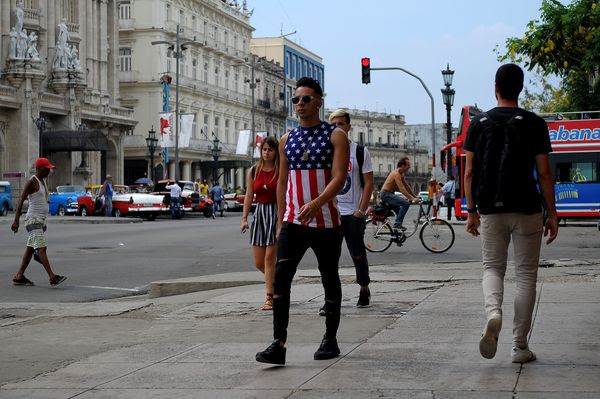
A Cuban wearing a T-shirt with the U.S. flag walking in Havana on June 15. (Yamil Lage/Agence France-Presse via Getty Images) The big question The Trump administration has indicated for months that it would roll back former president Barack Obama’s decision to normalize relations with Cuba. On Thursday evening, the White House finally announced a slew of new regulations that will reimpose some restrictions on trade, travel and other American dealings with the Communist-run island. So we asked Post Latin America correspondent Nick Miroff: Just how far do the Trump administration’s actions go? “The rollback doesn’t appear to be the sledgehammer many feared (or hoped for). It will restrict or prohibit business deals with Cuba’s military-affiliated conglomerate, GAESA, and it instructs the Treasury Department to tighten up U.S. travel to the island by forcing Americans back toward organized tours, rather than allowing to them go independently. “But the new policy appears to leave much of the Obama opening intact. Embassies will remain open. U.S. commercial flights will continue. Airbnb can continue working with Cuban bed-and-breakfast operators. Cruise ships can keep coming, and the new policy won’t attempt to limit Cuban Americans’s ability to visit their relatives or send them cash. “And, yes, Americans will still be able to bring cigars and rum back in their suitcases. “Of course, the enforcement details of the new policy haven’t been written. Without those, it’s hard to tell how much the changes will affect travel from the U.S. — which is on pace to double in 2017 — or who they’ll harm more: the government or ordinary Cubans. “Either way, it seems anti-Castro politicians may be coming around to the idea that Cuba’s private sector can drive reforms. That was a big part of President Obama’s justification for normalizing ties, and it didn’t get much Republican support. But in a Thursday interview with the Miami Herald, Sen. Marco Rubio (R-Fla.) praised Cuba’s emerging entrepreneurial sector as a force for change — the first time I can remember him doing so. “Politicians like Rubio used to pooh-pooh the idea that U.S. policies should help Cuba’s small businesses. But now those businesses employ a quarter of Cuba’s workforce. It will be interesting to see if the new regulations are written in a way that helps those entrepreneurs succeed — or ends up hurting them by chasing so many potential American customers away.“ |
The New York Times cautions President Trump to make sure he doesn’t spark a backlash from Cuba over his new policy changes, leading to a crackdown that harms ordinary Cubans. And The Post has some real talk about the administration’s attempts to take a tougher line on North Korea. In Britain, the start of Brexit talks is imminent, and news sites in both Britain and Germany say the outlook is bleak for the U.K.’s negotiators.
|
|||||||||||||||||||||||||||||||||||



 |
|||||||||||||||||||||
Conspiracy theories are seemingly having a moment in the U.S., which may be no surprise: Psychologists say they proliferate during times of deep uncertainty and partisanship. Mic compiles five of the most outrageous claims by Alex Jones, founder of far-right website Infowars, while Vox points out some examples of the left’s susceptibility to outlandish stories about Russia. But false stories can have real world consequences: on Wednesday night, a fake tip about a bomb threat forced a section of the Port of Charleston in South Carolina to close for several hours.
|


|

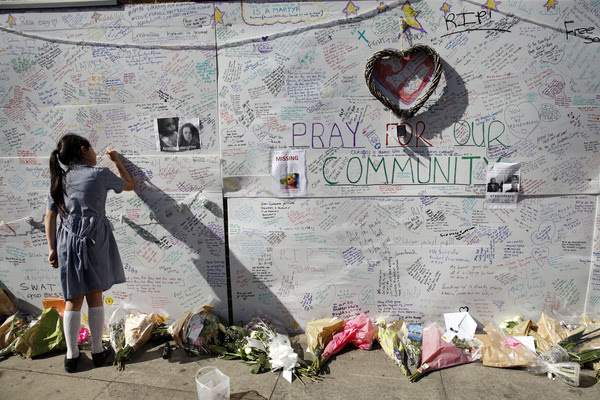 Londoners are still mourning after
|
||||||


|
 |
|||||||||||||||||||||
|


