
Free caregiving class in Los Altos library

Please share this post. Free class on caring for seniors with Alzheimer’s, Parkinson’s , stroke and other health issues.
Topics include nutrition, exercise, metabolism, medications, brain, stress, nervous system, immune system, skin, senior safing homes, preventing emergencies, symptoms of aging brain, and Q&A.
Email motherhealth@gmail.com for more info.
And Saturdays in Mountain View library.


Alcohol Boosts Recall of Earlier Learning
Summary: A new Scientific Reports study reveals alcohol may have a surprising effect on learning and memory. Researchers found those who drank alcohol following a learned word task had better recollection of the terms they learned the next day than those who did not drink.
Source: University of Exeter.
Drinking alcohol improves memory for information learned before the drinking episode began, new research suggests.
In the University of Exeter study, 88 social drinkers were given a word-learning task. Participants were then split in two groups at random and told either to drink as much as they liked (the average was four units) or not to drink at all.
The next day, they all did the same task again — and those who had drunk alcohol remembered more of what they had learned.
The researchers are keen to stress that this limited positive effect should be considered alongside the well-established negative effects of excessive alcohol on memory and mental and physical health.
“Our research not only showed that those who drank alcohol did better when repeating the word-learning task, but that this effect was stronger among those who drank more,” said Professor Celia Morgan, of the University of Exeter.
“The causes of this effect are not fully understood, but the leading explanation is that alcohol blocks the learning of new information and therefore the brain has more resources available to lay down other recently learned information into long-term memory.

“The theory is that the hippocampus — the brain area really important in memory — switches to ‘consolidating’ memories, transferring from short into longer-term memory.”
The effect noted by the researchers has been shown under laboratory conditions before, but this is the first study to test it in a natural setting, with people drinking in their homes.
There was also a second task which involved looking at images on a screen.
This task was completed once after the drinkers had drunk alcohol and again the following day, and the results did not reveal significant differences in memory performance post-drinking.
The study’s participants were 31 males and 57 females, aged 18-53.
ABOUT THIS NEUROSCIENCE RESEARCH ARTICLE
Source: Alex Morrison – University of Exeter
Image Source: NeuroscienceNews.com image is in the public domain.
Original Research: Full open access research for “Improved memory for information learnt before alcohol use in social drinkers tested in a naturalistic setting” by Molly Carlyle, Nicolas Dumay, Karen Roberts, Amy McAndrew, Tobias Stevens, Will Lawn & Celia J. A. Morgan in Scientific Reports. Published online July 242017 doi:10.1038/s41598-017-06305-w
CITE THIS NEUROSCIENCENEWS.COM ARTICLE
University of Exeter “Alcohol Boosts Recall of Earlier Learning.” NeuroscienceNews. NeuroscienceNews, 24 July 2017.
<http://neurosciencenews.com/earlier-learning-alcohol-7157/>.
<http://neurosciencenews.com/earlier-learning-alcohol-7157/>.
Abstract
Improved memory for information learnt before alcohol use in social drinkers tested in a naturalistic setting
Alcohol is known to facilitate memory if given after learning information in the laboratory; we aimed to investigate whether this effect can be found when alcohol is consumed in a naturalistic setting. Eighty-eight social drinkers were randomly allocated to either an alcohol self-dosing or a sober condition. The study assessed both retrograde facilitation and alcohol induced memory impairment using two independent tasks. In the retrograde task, participants learnt information in their own homes, and then consumed alcohol ad libitum. Participants then undertook an anterograde memory task of alcohol impairment when intoxicated. Both memory tasks were completed again the following day. Mean amount of alcohol consumed was 82.59 grams over the evening. For the retrograde task, as predicted, both conditions exhibited similar performance on the memory task immediately following learning (before intoxication) yet performance was better when tested the morning after encoding in the alcohol condition only. The anterograde task did not reveal significant differences in memory performance post-drinking. Units of alcohol drunk were positively correlated with the amount of retrograde facilitation the following morning. These findings demonstrate the retrograde facilitation effect in a naturalistic setting, and found it to be related to the self-administered grams of alcohol.
“Improved memory for information learnt before alcohol use in social drinkers tested in a naturalistic setting” by Molly Carlyle, Nicolas Dumay, Karen Roberts, Amy McAndrew, Tobias Stevens, Will Lawn & Celia J. A. Morgan in Scientific Reports. Published online July 242017 doi:10.1038/s41598-017-06305-w
Universal health care would save us $17 trillion
Universal health care would save us $17 trillion
Universal health care or single-payer health care would save us $17 trillion over 10 years.
In order to demonstrate this, we just need a couple of numbers. The first number is how much we currently spend on health care per year.
National Healthcare Expenditure (NHE)
This is a number called the National Healthcare Expenditure (NHE). NHE measures everything we spend on health care — both public and private. In 2015, the NHE was $3.2 trillion or $9,990 per person per year.
That $9,990 per person makes us the most expensive healthcare system in the world. It was this way before the Affordable Care Act (ACA) as well. In 2013, the Organization for Economic Co-operation and Development (OECD) calculated the average worldwide healthcare spend per person at $3,453.
Back to our number: $3.2 trillion in 2015. It increased to $3.4 trillion in 2016.
Growth rate
As you can see, the amount of spending per year doesn’t stay the same. It grows on a yearly basis. So the second number we need is the growth rate.
According to the study titled “National Healthcare Expenditures, 2016-2025: Price Increases, Aging Push Sector to 20 Percent of Economy,” health care costs in the United States are estimated to grow at an average annual rate of 5.6 percent from 2016 to 2025.
If we apply this growth rate over 10 years, and add up the costs, our current healthcare system will cost $49 trillion.
Savings
$49 trillion (current system) — $32 trillion (single payer) = $17 trillion in savings.
Over a 10-year period, universal health care or a single-payer system would save $17 trillion.
Yes, you read that right … universal health care would cost $17 trillion less over 10 years. A universal health care system would save us $1.7 trillion a year.
What’s the problem then?
The problem is that certain industries have very powerful lobbies. And these industries spend a lot of money on advertising to make sure that additional $17 trillion goes to them.
The corporate special interest group Foundation for Economic Freedom (FEE), a group that helped make Milton Friedman a name people recognize, used the exact same numbers we’ve been discussing to write “Bernie-Care Would Cost $32 Trillion, Twice What Sanders Claimed.”
You’re not going to believe this, but nowhere in the article do they mention that it would also save us $17 trillion over our current system. Instead they focus on how federal spending would increase.
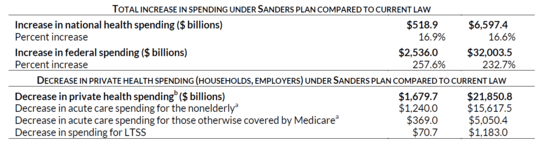
You know why federal spending would increase? Because we wouldn’t be paying for insurance out of our own pockets. The reason for the increase is simply that private spending moves to public spending. As illustrated in the excerpt from the Urban Institute’s analysis of universal health care, roughly $22 trillion of private spending on health care moves to public spending. Overall, however, we’d spend $17 trillion less over 10 years and we could insure everyone.
The next time someone tells you we need to reform health care, show them how we could easily save $17 trillion if we just did what every other developed country in the world does when it comes to health care.
David Akadjian is the author of The Little Book of Revolution: A Distributive Strategy for Democracy (also available as an ebook).
Voices from Foreign Policy
|
||||||||
|
||||||||
|
||||||||
|
||||||||
|
||||||||
|





Digital Health News
|
|
Survey on best design for a senior health care resource web site
Survey on best design for a senior health care resource web site
Send your comments on the best design for a senior health care resource web site where you can find care, match your needs, answer your important questions, save you money, connect with experience and community support teams, and other tasks and information you need in a perfectly designed web site for senior health care resource and more. motherhealth@gmail.com or text 650-946-3368 or 408-854-1883


new caregivers brochure motherhealth
Top posts 7-21-2017
Source: Top posts 7-21-2017
Top posts 7-21-2017
High school website teach savvy interns needed by Motherhealth to jazz up this site
High school website teach savvy interns needed by Motherhealth to jazz up this site
- We found some dynamic urls on your site. Unless they are needed for tracking purposes, we recommend to remove them.
- You should avoid having more than 100 links on any given page.
- It looks like you have iframe content on your site. For best SEO results we recommend that you not place content within iframes.
- You need to increase your back links, you should consider creating an email outreach program.
- Create more content rich pages, as it will help you rank for more long tail keywords.
- We found links with the rel=”nofollow” attribute on them, these links don’t influence the target’s Page Rank.
- Title tags are an important on-page factor for SEO. Your title tags should contain fewer than 70 characters. This is the limit Google displays in search results.
- We noticed that you have heading tags that are too long or too short. Its best to keep your heading tags between 15 and 65 characters.
- We found tags that don’t include the alt attribute. Since search engines can’t see the image, including an alt tag helps search engines know what you are showing on your site.
- The majority of the keywords are not found in the site title. Make sure you place your most descriptive keywords in the site title.
- The majority of the keywords are not found in the meta description. Make sure you place your most descriptive keywords in the meta description.
- The majority of the keywords are not found in heading tags. Make sure you place your most descriptive keywords in heading tags.
- Look to combine all scripts into a single script, and similarly combining all CSS into a single stylesheet. This is the key to faster pages.
- Minify JavaScript and CSS. Minification is the practice of removing unnecessary characters from code to reduce its size thereby improving load times
- Reducing the number of unique hostnames has the potential to reduce the amount of parallel downloading that takes place in the page. Avoiding DNS lookups cuts response times
- Move your stylesheets to the document makes pages appear to be loading faster. This is because putting stylesheets in the allows the page to render progressively
- Compress components with gzip, this generally reduces the response size by about 70%.
- Configure entity tags (ETags). Entity tags (ETags) are a mechanism that web servers and browsers use to determine whether the component in the browser’s cache matches the one on the origin server
- Reduce the number of DOM elements. A complex page means more content to download and it also means slower DOM access in JavaScript
Dear High school tech savvy students,
You can intern at my company to spruce up this web site http://www.clubalthea.com and to generate more traffic. The list above shows the amount the work needed to clean up 8000 health posts. We are currently receiving >500 views a day.
Remote work is ok.
Regards,
Connie Dello Buono
site owner
non-profit owner at Green Research Institute 501c3